
Unlocking Agricultural Excellence
7 Practices the World's Largest Growers follow
to manage their operations
For the past 7 years we have been working closely with some of the world’s largest growers and food producers. We have learned their practices with one goal in mind - refine and optimize their operations to achieve compound optimization.
We would like to share with you the key principles we’ve learned, to help you unlock agricultural excellence.
If you watched the video and you would like to know more, fill in your details in the form below. We'll follow up with some exclusive content and offers.
Or >> keep scrolling to keep reading >>

KEEP SCROLLING TO KEEP READING
1. Understanding “Compound Optimization”
Small improvements make a huge difference. Market leaders understand the concept of compound optimization and are constantly looking for ways to improve and optimize every stage of their operations.
Let's go over a simple example to demonstrate the power of compound optimization:
Ben’s agro company makes a revenue of 5000$ per Ha per year, his expenses are 4000$.
That leaves him with a 1000$ profit.
In year 1 of Ben’s optimization process, he managed to increase his revenue by 2% and save 3% of his expenses. That would make his revenue 5100$ and expenses 3880$ leaving him with a profit of 1220$ which is 220$ more than last year. An astonishing 22% growth in profit compared to last year.
In year 2 of Ben’s optimization process, he again managed to increase his revenue by 2% and save 3% of his expenses. That would make him a profit of 1438$. 44% growth in profit over a period of 2 years!
For a 1,000Ha grower that would mean extra 438,000$ per year and for a 10,000Ha grower, above 4 million!
It took him 2 years, and this is just the start!
2. The 2023 version of a MAP is a Digital twin
Farm operations are happening out in the real world, and the tools to be used to manage it, should represent the real world in the most genuine way. For the past few decades, growers have been using printed maps and paper reports to manage their operations, the advanced among them, set up a team of GIS and data analysis experts to log these reports and try and extract valuable data from them using a GIS software and Excel. Besides the waste of paper, there are a few other disadvantages to using these methods:
- It takes a huge effort to collect and organize all the data
- The data collected is limited to observations made and logged by field workers
- The processing time can take days if not weeks, extending time to action to a point where it might be too late.
To be able to see the big picture and at the same time, control every small operation, Market leaders look for a centralized fast and reactive tool, to digitally log and manage farm events. Some of them have millions of scouting events per year. They are laying all their different data layers on top of a digital twin of their farm and use AI smart analysis to focus on the areas they prioritize the most.
The same way we digitized communication using smartphones and emails, the same way we digitized navigation using navigation apps like Google maps or Waze, managing farm operations digitally is not something of the future, it is here and now, and it is working!


_edited.jpg)
3. Data-Driven Decision Making
Here is how data driven decisions work. Instead of dealing with all problems simultaneously, you collect data, analyze it focusing on different issues, measure their influence on your desired outcome and then prioritize your efforts based on the analysis and measurements.
If you have a high level of infestation, scouting and spraying will be prioritized over solving irrigation issues etc. Both can be digitally planned and managed to keep a real-time track of the progress.
One of our customers has implemented this method when prioritizing and focusing
on bindweeds treatment. They managed to decrease the number of infected trees
by 900,000 trees through 2023, increasing revenue by 4.5Million US dollars.
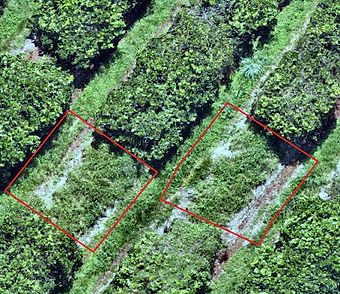
In the same matter, counting empty spots and dead trees, and prioritizing replanting, help growers use the area they have to the optimum, leading to thousands of trees that can be added to their assets.

4. Precise application of resources
Smart and efficient use of resources can make a huge difference. By resources, I don't only mean optimizing the amount of chemicals used for spraying or fertilization. I also mean optimizing the time of your workers, what do they do? where? and when?
The world’s largest growers are managing their workforce with precise missions and goals. Instead of wandering across the farm without purpose, their missions are pre-planned and downloaded to their phones. Execution is tracked and logged, the outcome is - workers that accomplish more!
In spraying applications, growers optimize amounts of materials according to the measured average tree volume in each block, or even use variable rate spraying to save on chemicals. Just avoiding spraying in empty spots can reduce use of chemicals by 10%-20%.


5. Quality of execution
Giving instructions is easy, execution is where things get difficult. Missions should be clear and simple to understand and also location specific, general missions will usually lead to underperformance.
The best growers adopt a system to assign predefined, pre planned missions to their workers. The system allows them to track execution and progress of each mission, with in field reports and pictures. In some cases a mission is assigned to a group of workers for coordinated and synergetic execution.
The amazing thing about digital execution is that it reduces time to action from weeks, to less then a day! Imagine field scouters scout for pests in the morning and sprayers spray just a few hours later based on the data reported.

6. Learning what works and what doesn't
By embracing digital technology to measure, plan, and connect your workforce and machinery, you gain insights essential to your farm's success.
This approach enables you to answer pivotal questions: why certain blocks outperform others? Are there areas in the farm that lose money? Which methods and inputs drive success? and what factors contribute to underperformance?
With this knowledge, you can refine your long-term strategy, from adjusting irrigation regimens and selecting appropriate rootstocks to timing specific practices. This data-driven process is key to optimizing your farm's overall performance and sustainability.
7. Investing in the future
Market leaders are constantly keeping up to date with technology and innovation. These past few years have been the years of AI, and while generating texts and images is fun, the real impact comes from real world based AI applications. Agriculture is not left behind, AI algorithms are used to improve accuracy, boost productivity and efficiency and help growers optimize their operations.
We hope you enjoyed the reading. We trust these principles will be valuable to you.
They are the result of hard-earned lessons, supported by effective tools, efficient processes, and real-world success stories.
If you found these tips useful and you would like to know more, fill in your details in the form below. We'll follow up with some exclusive content and offers.